Repointing failed mortar
We remove eroded mortar from the joints and repack them with fresh material matched to the brick. This restores the seal between bricks and stops water from tracking down through the wall.
Serving Tamarac, FL · (954) 833-6103
Chimney repair in Tamarac, FL for cracked brick, failing mortar, damaged crowns, and leaks. We fix water damage driven by humidity and salt air.
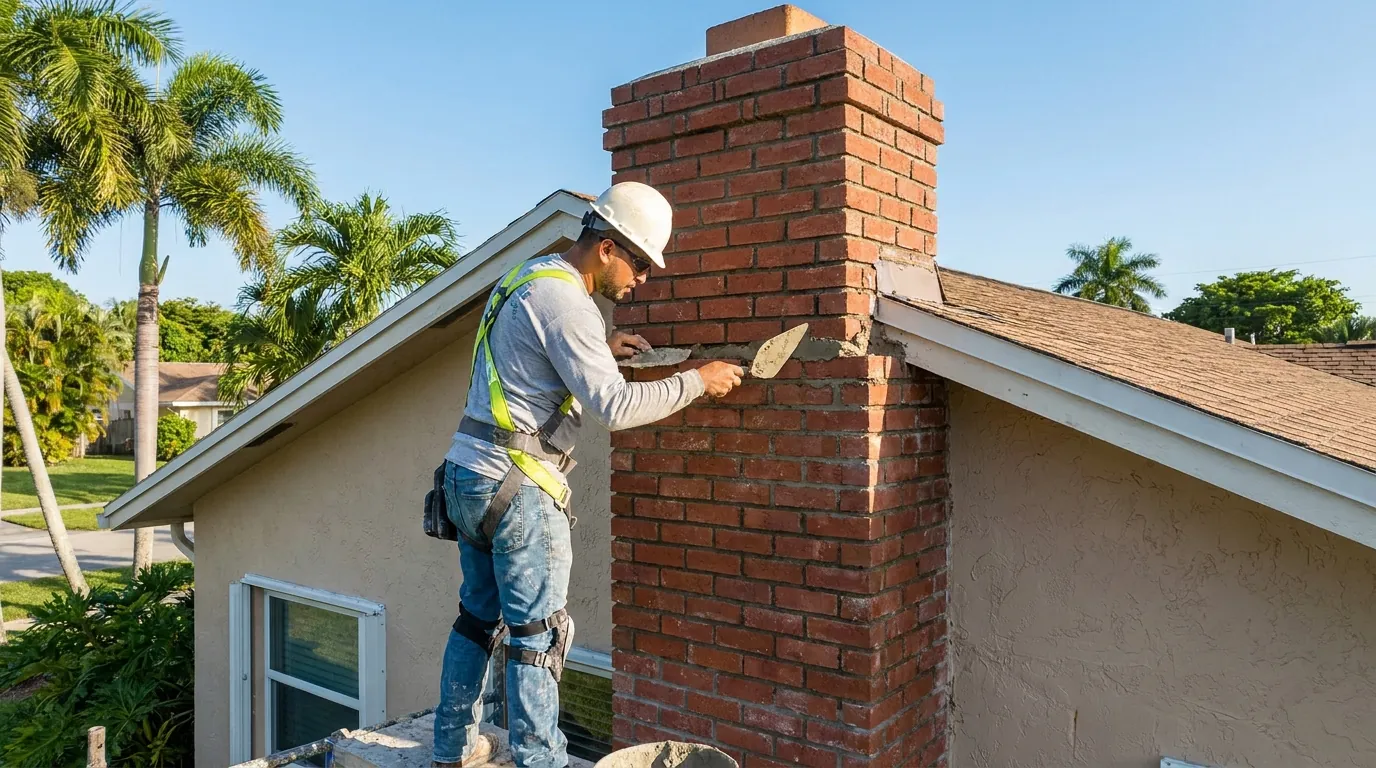
This page is about repair — the work you need once a chimney has started to fail. That is different from a fresh build or a full replacement. Repair means finding the specific problem, whether that is eroded mortar, cracked brick, a failing crown, or a leak at the flashing, and correcting it before it damages the rest of the structure or the house underneath.
In Tamarac, most repair calls trace back to water. The chimney is the most exposed masonry on the house, standing above the roofline where it takes wind-driven rain, constant humidity, and salt-laden air from every direction. Water finds the weakest point — a hairline crack in the crown, a gap where the cap has loosened, a joint where the mortar has washed thin — and works its way in from there.
The right repair depends entirely on catching the source. If a leak is coming from the flashing, replacing brick does nothing. If the crown is cracked, sealing the joints below it just delays the problem. Our full chimney masonry repair service page describes the inspection process we use to trace a problem to its origin, and if the structure is too far gone to repair, our chimney masonry repair installation page covers rebuild options.
Most repairs fall into a handful of categories, and they often appear together once water has been getting in for a while.
We remove eroded mortar from the joints and repack them with fresh material matched to the brick. This restores the seal between bricks and stops water from tracking down through the wall.
Bricks that have flaked, cracked, or crumbled get cut out and replaced. Leaving damaged units in place lets water reach the interior of the stack and weakens the surrounding masonry.
A cracked crown is one of the most common leak sources. We patch small cracks or rebuild the slab so it sheds water away from the flue and brickwork below.
Where the chimney meets the roof, failed flashing lets water into the attic and ceilings. We reseal or replace it to close that path — often the real fix behind a stain blamed on the brick.
A corroded or missing cap lets rain and debris straight into the flue. Replacing it is a quick repair that prevents much larger interior problems.
Some chimney problems announce themselves clearly, and others hide until the damage is serious. From the ground, look for gaps or missing chunks in the mortar joints, brick faces that are flaking or discolored, a leaning stack, and a cap that is rusted, tilted, or gone. Inside the house, watch for water stains on the ceiling or wall near the chimney, a damp or musty smell around the fireplace after rain, and white powdery deposits on the brick, which signal that water is moving through the masonry.
In our climate these signs escalate faster than most homeowners expect. Because the masonry rarely dries out between rains, a joint that is thinning in spring can be an open leak by the end of storm season. A cap that is just starting to rust in the salt air can corrode through within a couple of years. Catching these early keeps a repair small.
If you are trying to gauge what a fix might run before you call, our guide to chimney repair cost in Tamarac explains what makes one repair inexpensive and another significant — mostly access, the extent of water damage, and whether the crown or flashing is involved.
Tamarac's high humidity and heavy summer rainfall mean repairs have to account for water that never really goes away. We favor materials and methods that let the masonry breathe while shedding surface water, rather than sealing everything airtight and trapping moisture inside the brick, which causes its own damage.
Salt air is a quieter factor. It corrodes metal steadily, so on repairs we pay attention to caps, flashing, and any fasteners, using components that will hold up in a coastal environment. The region's sandy soils and high water table can also affect the chimney's base over time; ground that stays saturated or shifts unevenly can open cracks that appear higher up in the stack, which is why we look at the whole structure rather than just the spot you noticed.
Describe what you are seeing and we will help you figure out whether it is a small repair or something that needs prompt attention. We serve Tamarac and the surrounding area.
Serving Tamarac, Sunrise, Lauderhill, Margate, Coral Springs, Plantation, and Coconut Creek.
It often is, but the source may be the flashing or crown rather than the brick itself. Water usually enters at the top or where the chimney meets the roof and shows up as a stain lower down. Finding the true entry point is the first step, because repairing the wrong area won't stop the leak.
Many chimneys need only targeted repairs — repointing a section of joints, replacing a few bricks, or fixing the crown. A full rebuild is only necessary when the structure has deteriorated too far to repair safely. We look at the whole chimney to tell you which situation you're in.
A cracked crown lets rain run straight into the chimney and the wall below, so it tends to cause spreading damage. In our rainy, humid climate that damage accelerates, so a cracked crown is worth addressing before the next storm season rather than after.
That's efflorescence — mineral salts left behind as water moves through and evaporates off the masonry. It's a visual sign that water is getting into the brick. On its own it's not structural, but it tells you there's a moisture problem worth tracing to its source.